- Judith Guthrie's Nose Dogs Newsletter
- Posts
- Scent Work Presentations — What They Are and How They Support the Search
Scent Work Presentations — What They Are and How They Support the Search
Understanding One of the Most Misunderstood Tools in Scent Work

Judith Guthrie
March 07, 2026
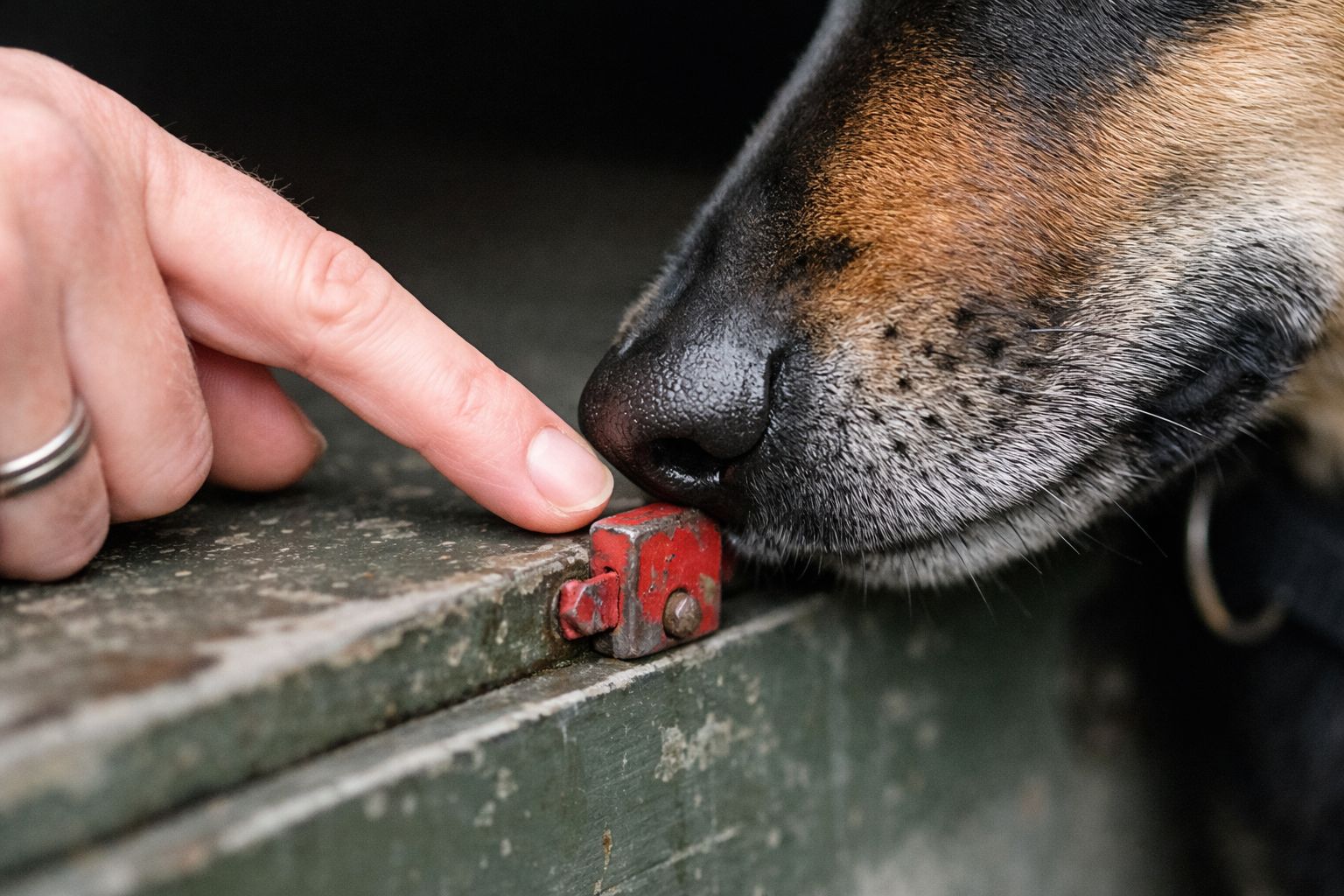
This is the first in a three-part series on presentations in sport scent work. We’re going to look at what presentations actually are, how they’re commonly misused, and how to use them without creating dependence or confusion.
Presentations are one of the more misunderstood tools in competitive scent work. There’s a strong belief that the dog should search independently and the handler should not intervene. I agree that independence matters. I want an independent searching dog that hunts without waiting for direction.
But scent work is a team sport.
Part of your responsibility as a handler is to support your teammate. Sometimes that means communicating about a space they have not yet accessed. That is not taking over the search. It is communication.
In professional detection dog work, presentations are used when necessary. When the stakes are high, handlers communicate about priority areas. The goal is not control. The goal is success. Presentations are simply another way we communicate with our dogs.
They are not there to run the search. They are there to communicate something you notice as a teammate: a space your dog hasn’t pushed into, an object they missed, or a productive feature that deserves attention.
Used intentionally, presentations are a powerful tool. Used reactively, they create confusion and dependence.
Presentations Are Communication
There is a difference between helping your dog access a space and leading your dog around like you’re revealing letters on a game show.
If you’ve ever watched the beginning of a puzzle on Wheel of Fortune, Vanna White walks across the board with a broad, sweeping arm motion, gesturing toward the whole puzzle. It’s theatrical. It’s general. It’s not specific.
That sweeping, “go check all of this” motion is what I mean by Vanna White-ing.
And if we’re honest, most of us have done it.
You get worried they missed a corner, a seam, the underside of a shelf. So your arm sweeps across a general area. Check this whole section. Maybe here. Maybe there.
Now your dog isn’t hunting odor. They’re hunting motion.
That’s not what we want.
But freezing because you’re afraid to influence your dog isn’t better. Standing there as if moving your shoulder will ruin the search is just fear in the opposite direction.
The problem isn’t the presentation. The problem is a lack of clarity.
Presentations are communication.
What a Presentation Actually Means
When I make a presentation, I want it to mean something precise. I want you on this seam, on this shelf, or right here. And when I say “right here,” I mean a specific location, not a broad area.
A presentation gives information about where to check. It does not promise source.
If presentations are only made when the dog is at source, the dog can begin to associate the handler’s gesture with reinforcement. When that happens, priority can shift away from confirming odor and toward completing the behavior the handler indicated.
That’s where falsing risk begins.
Presentation means check. Odor means reinforcement. Those are not the same thing.
The Working Hierarchy
If presentations are going to stay clean, they have to live inside a clear hierarchy.
Independent hunt is the default. That is the foundation of the search. The dog’s job is to build the search and solve odor.
Odor always outranks handler input. If my dog has odor and I present somewhere else, I expect intelligent disobedience. I expect the dog to ignore me and keep doing what they are doing.
That is not stubbornness. That is the correct priority.
Presentations sit below odor in the hierarchy of behavior. They are information about access, not instruction about source. When the dog is solving a puzzle, working a plume, or processing information, my job is to stay out of the way. When odor is not present, I can communicate about space.
Independent hunt builds search drive, and intelligent disobedience protects it. Presentations should never override either one.
If a dog leaves odor to follow a hand, that reflects reinforcement history, not handler leadership.
When Presentations Become Noise
Problems begin when communication turns into motion without meaning.
When handlers start Vanna White-ing, sweeping across general areas instead of directing to something specific, the message becomes vague. The dog either abandons odor to follow movement, or starts waiting for more direction instead of continuing to hunt.
Neither outcome supports independence.
If your presentation lacks clarity, your dog has to guess what you meant. If you use it consistently, your dog learns to pause and wait for input rather than search on their own.
That is how dependence starts, and it usually happens gradually.
I do not want a dog that hunts hands. I want a dog that hunts odor.
The Physical Picture
Because presentations are communication, your whole body contributes to the message, whether you intend it to or not.
It is never just the hand. If my dog is approaching me and I want them to access a particular space, I may adjust my position slightly to open that path and close another. My body orientation, my shoulders, the direction of my feet all influence the communication.
If I want my dog to move to the right, I use the right side of my body to support that direction. Reaching across my midline blocks access and creates conflicting signals. The dog receives one message from the arm and another from the body and must decide which one to follow.
Most dogs will default to motion over odor when that conflict exists.
The physical picture should match the intended direction of travel. When the body supports the message instead of contradicting it, the dog can stay focused on the task.
Next month, I’ll break down how to train presentations so they remain informative rather than instructional, including how reinforcement timing shapes priority and how to proof your own handling errors.
For now, remember this hierarchy: hunt remains the foundation. Odor remains the highest priority. Presentations remain communication.
If you would like more personalized coaching or prefer to arrange an in-person seminar at your location to help you implement these concepts, please don’t hesitate to contact me.